
 On Sunday morning, I attended a prayer service in Philadelphia that included about 200 people from about twenty different spiritual traditions. I wept as I listened to a Bahá’í leader read a prayer for the future of the United States written over a hundred years ago. Her prayer was followed by Buddhist, Catholic, Jewish, Muslim, Evangelical, and other types of prayer, which kept my eyes watering.
Before we were invited to shake hands with those around us, we heard the Gospel verse that says that before you make an offering to God, you should reconcile with your neighbor. A Mormon woman from Utah offered me a hug while people from across the United States — and across political camps — greeted each other warmly.
The prayer service was one of the final sessions of the Braver Angels national conference, where I had been invited to speak on a panel about peace. Founded after the 2016 election to bridge the partisan divide, Braver Angels grew to include over 15,000 members. Clearly they are meeting a need for connection in our divided country. At conference mealtimes, many people sought out strangers who were wearing different colored nametag lanyards — with red, blue, and yellow indicating Republican, Democratic, or Independent political leanings. Unlike the holiday dinner table, where political disagreement is often unwanted or even explosive, in this environment there was a shared desire for dialogue. It was refreshing.
Civil political dialogue isn’t just about feeling good. It is one way to counter the demonization that increases the risk of political violence. I learned this from Quaker traveling minister Emily Provance at a workshop she led nearly two years ago. Based on research on election-related violence, Emily made the case that disagreeing on issues is healthy and necessary, but a culture that normalizes insults and verbal attacks increases the likelihood of physical attacks. As someone who feels called to serve as a peacekeeper amid potential conflict, this hit home. At the Braver Angels conference, I got to tell Emily how that insight made me more aware of the language I use, even as I strongly critique national leaders pursuing unjust and often violent policies.
The photo above shows a hand gesture sometimes used to symbolize the power of nonviolence: one hand is outstretched seeking connection while the other is raised in a signal to stop. Sending both messages at once can be challenging, but I think of influential abolitionist John Woolman who visited fellow Quakers “in a friendly way” while paying the people his hosts enslaved for food preparation and other services. My own experience includes interrupting a corporate shareholder meeting while acknowledging the pressures faced by the CEO.
My observation as an activist, and as a student of history, is that treating people as human beings while challenging their destructive behavior or policies gets better results than shouting at them, or engaging in dialogue alone.
While I appreciated the people I met at the Braver Angels conference, I was repeatedly reminded that dialogue alone won’t change unequal power balances, especially when not all parties are at the table. This was a noticeable weakness of the conference, where participants were disproportionately white, and leaders were disproportionately male. Dialogue is also not enough to overturn laws championed by multibillion-dollar corporations or unequal access to voting and other rights. Dr King understood these dynamics and argued that we need to cultivate both love and grassroots power.
That’s why I plan to mark the 250th anniversary of the 4th of July by serving as a peacekeeper (also known as marshal or safety team) at a march and another nonviolent action designed to challenge the forces of authoritarianism and assert a practice of love that includes everyone. I suspect the speakers will reference the Declaration of Independence and point out all the ways US history has failed to live by its most famous line, that “all men are created equal.” I’ll also remember the declaration’s last line, which I learned at Braver Angels: “And for the support of this Declaration, with a firm Reliance on the Protection of divine Providence, we mutually pledge to each other our Lives, our Fortunes, and our sacred Honor.”
Finding nonviolent ways to protect and expand our democracy will continue to be an important focus of my work. After the Braver Angels conference, ’ll be showing up with a greater awareness of the Republicans who are also longing for our country to change course. One used King’s term “Beloved Community” for the world she wants to see. We’ll need all of us to attain King’s vision, which was grounded in justice, not just friendliness.
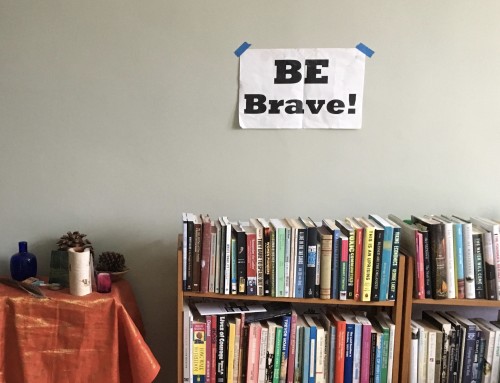
We’ll also need more courage to interrupt, as Dr King put it, “everything that stands against love.” As it happened, courage was one of the themes of the interfaith prayers that made me cry at the Braver Angels service. May it be so.

P.S. Since posting, I’ve tweaked the line about John Woolman to make my wording more accurate.